
AI image enhancement has changed the way we think about improving digital images.
Artificial intelligence can transform a blurry photograph, a small image, an old scan, or a heavily compressed picture into a much cleaner, sharper result.
But what’s happening behind the scenes?
AI image enhancement is much more than increasing the number of pixels or applying a stronger sharpening filter.
Modern AI models can analyze patterns in images, learn relationships between low- and high-quality visual data, and use those patterns to reconstruct details that may have been degraded or lost.
That raises an interesting question: How does an AI model know what a better image should look like?
The answer involves pixels, tensors, neural networks, training data, feature extraction, mathematical optimization, super-resolution, image restoration, and increasingly sophisticated generative models.
In this guide, we will look at the complete process behind AI image enhancement, from the original pixels to the final result.
What Is AI Image Enhancement?
AI image enhancement is the use of machine learning models to improve the visual quality of an image.
Traditional image editing normally relies on predefined mathematical operations. A sharpening filter, for example, can increase local contrast around edges. A resizing algorithm can interpolate new pixels between existing pixels.
AI-based enhancement takes a different approach.
Instead of relying entirely on fixed rules, an AI model can learn visual patterns from large collections of training images.
During training, the model is exposed to examples and adjusts millions, or sometimes billions, of internal parameters to become better at a particular task.
Image enhancement can involve several different problems, including super-resolution, denoising, deblurring, compression artifact reduction, and image restoration.
Research such as the SwinIR project demonstrates how modern neural networks can address super-resolution, denoising, and JPEG artifact reduction within image restoration systems.
The key point is that no single AI enhancement technique works for every image. Different models and architectures can be designed for different types of image degradation.
It All Starts With Pixels
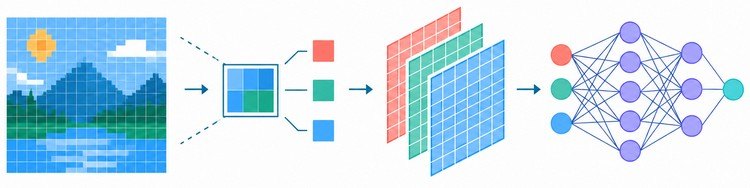
Before an AI model can enhance an image, it needs to convert the image into numerical information.
A digital RGB image is essentially a grid of pixels. Each pixel contains numerical values representing its color channels. In a common 8-bit RGB image, each channel can contain a value from 0 to 255.
A red pixel could therefore be represented approximately as:
R = 255, G = 0, B = 0
An entire image becomes a large collection of these values.
For an AI system, the image is typically represented as a tensor. Think of a tensor as a structured numerical container that holds the image data.
The simplified process looks like this:
Image → Pixels → Numerical values → Tensor → Neural network
The model does not look at the photograph in the same way a person does. It processes numerical patterns and learns representations that can be useful for reconstructing or improving the image.
This is the foundation of AI image enhancement.
Why Improving an Image Is a Difficult Problem
The biggest challenge is information loss.
Imagine starting with a 2,000 × 2,000 pixel photograph and reducing it to 500 × 500 pixels.
The smaller version contains dramatically fewer pixels. Fine textures, tiny edges, hair strands, small text, and other visual information may disappear during the process.
If you later enlarge the 500 × 500 image back to 2,000 × 2,000 pixels, the resizing algorithm has to create additional pixels.
Traditional interpolation can estimate these pixels mathematically.
AI can take a different approach.
The model can use patterns learned during training to estimate what visual structures are likely to exist in the missing areas.
This creates the fundamental problem behind many image enhancement systems:
Low-quality image → missing or degraded information → AI reconstruction → enhanced image
AI is not simply copying information from somewhere else in the photograph. It is making predictions based on patterns it has learned.
How AI Models Learn to Create Better Images

One of the most important parts of the process happens before you ever upload an image to an enhancement tool.
The model has to be trained.
A simplified training example might begin with a high-quality photograph. Researchers can deliberately degrade an image by reducing its resolution, adding noise, introducing blur, or applying compression.
The original image becomes the target.
The degraded version becomes the input.
The model then attempts to reconstruct the original.
The basic training process looks something like this:
High-quality image → Artificial degradation → Low-quality input
Then:
Low-quality input → AI model → Predicted high-quality image
The prediction is compared with the target image.
If the result is different from the target, the model calculates an error, often represented through a loss function.
The model then uses backpropagation and gradient-based optimization to adjust its internal parameters.
The process repeats thousands or millions of times.
Over time, the model learns patterns that help it make better predictions.
This is one reason AI image enhancement can perform surprisingly well. The model isn’t programmed with a giant collection of individual sharpening instructions.
It learns statistical relationships from training examples.
What Happens Inside the Neural Network?
This is where AI image enhancement becomes particularly interesting.
A neural network contains layers that transform the input into increasingly useful representations.
At an early stage, the network may detect relatively simple patterns such as edges, color transitions, and basic textures.
Deeper layers can represent more complex structures.
A simplified progression might look like this:
Pixels → Edges → Textures → Shapes → Structures → Visual patterns
For example, a network processing a photograph might detect the boundaries of an object before developing stronger representations of its texture and overall structure.
Modern image restoration models can use many layers and specialized components to preserve useful information while reconstructing degraded areas.
Residual connections are particularly important in many neural network architectures because they allow information to move through the network more effectively.
The details vary considerably between models, but the central concept remains similar: the network transforms raw pixel information into increasingly useful features before reconstructing the final image.
CNNs: Learning Visual Patterns With Convolution
Convolutional neural networks, commonly called CNNs, played a major role in the development of deep-learning-based image processing.
A convolution uses a small mathematical filter, often called a kernel, that moves across an image.
At each position, the kernel examines a local group of pixels and produces a numerical response.
Different learned filters can respond strongly to different patterns.
One filter might respond to an edge. Another might respond to a particular texture. Deeper layers can combine these simpler patterns into more complex representations.
This makes CNNs particularly useful for image restoration because images contain strong local relationships.
A pixel is rarely meaningful in isolation. Its surrounding pixels provide important information about edges, textures, shapes, and structures.
Super-Resolution: How AI Creates Larger Images
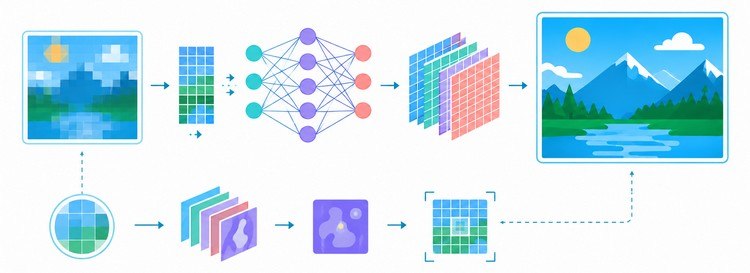
One of the most recognizable applications of AI image enhancement is super-resolution.
The goal is simple to describe:
Create a higher-resolution image from a lower-resolution input.
The technical challenge is much harder.
Suppose an AI receives a small photograph containing a person’s face. Some facial information may have been lost during resizing or compression.
The model needs to determine what structures are consistent with the available evidence.
The process can involve several stages:
Low-resolution image → Feature extraction → Feature processing → Reconstruction → High-resolution image
Modern super-resolution models do not necessarily enlarge the image first and then attempt to fix it. Many work with learned feature representations and reconstruct the high-resolution output from those representations.
Research on models such as FSRCNN helped demonstrate how deep networks could perform efficient single-image super-resolution, while later approaches introduced increasingly sophisticated architectures.
This is one of the clearest examples of how AI can produce better images by learning patterns instead of relying solely on traditional interpolation.
Where Do the New Details Come From?
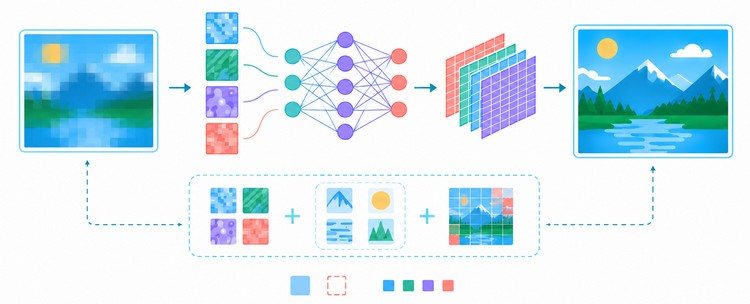
This is probably the most fascinating question in AI image enhancement.
If a tiny image does not contain enough information to show an individual hair strand, how can an AI produce one?
The answer is that the model has learned patterns from other images.
During training, the model may encounter enormous numbers of examples containing faces, buildings, landscapes, textures, objects, and other visual structures.
It learns statistical relationships between low-quality visual patterns and the higher-quality structures associated with them.
When it receives a degraded image, it can use those learned relationships to predict a plausible reconstruction.
But there is an important distinction here.
The resulting detail is not necessarily the exact original detail.
An AI model can create a visually convincing reconstruction that was not explicitly present in the input.
That means AI enhancement can sometimes be better described as informed reconstruction rather than simple recovery.
This distinction becomes especially important when working with faces, text, historical photographs, scientific images, or other situations where accuracy matters more than visual appearance.
AI Image Restoration Goes Beyond Upscaling
Super-resolution is only one part of the larger image restoration field.
AI models can also be trained to handle different types of image degradation, including sensor noise, motion blur, defocus, compression artifacts, and missing or corrupted details.
During training, the model learns statistical relationships between degraded images and their high-quality counterparts, allowing it to identify visual patterns and reconstruct information that has been distorted or lost.
Research such as SwinIR demonstrates how transformer-based models can be applied to several image restoration tasks, including super-resolution, denoising, and JPEG artifact reduction.
Instead of applying a fixed filter, the neural network analyzes features across the image and estimates the most likely clean representation.
This makes AI restoration a learned reconstruction process, where the model uses information from surrounding pixels and previously learned visual patterns to produce a more coherent and detailed result.
Denoising
Digital images can contain noise caused by sensors, low-light conditions, high ISO settings, transmission problems, or other factors.
A trained model can learn to distinguish useful image structures from unwanted noise. Instead of simply applying a fixed smoothing filter, a neural network can learn the statistical patterns of noise and estimate the clean image underneath it.
For example, the DnCNN approach uses deep convolutional neural networks and residual learning to remove noise while preserving important image details such as edges and textures. Read the DnCNN research paper.
Deblurring
Blur can result from camera movement, subject movement, incorrect focus, or optical limitations.
An AI model can learn patterns associated with blurred images and estimate a sharper representation. Instead of simply applying a predefined sharpening filter, the network learns how blur affects image structures and how those structures can be reconstructed.
For example, DeblurGAN uses a conditional generative adversarial network to perform end-to-end motion deblurring, learning to transform blurred images into sharper results. Read the DeblurGAN research paper.
Compression Artifact Removal
JPEG compression can introduce blocking, ringing, and other unwanted artifacts.
Modern restoration models can learn to reduce these patterns while preserving important edges and textures.
The SwinIR research is a useful example because its architecture was evaluated across super-resolution, denoising, and JPEG compression artifact reduction.
This demonstrates why the term AI image enhancement covers a much larger field than simple image upscaling.
Transformers Are Changing Image Enhancement
CNNs are not the only architecture used for image restoration.
Transformers have also become important in computer vision.
A notable example is SwinIR, which uses Swin Transformer components for image restoration. Its architecture includes shallow feature extraction, deeper feature extraction, and high-quality image reconstruction.
The idea behind transformer-based image processing is particularly interesting because the model can capture relationships across image regions instead of relying only on very local operations.
This can help when understanding an image requires broader context.
For example, a texture may be easier to reconstruct when the model understands the larger object containing that texture.
Transformers have therefore become an important part of the continuing evolution of AI image enhancement.
Diffusion Models and Generative Image Enhancement
Another major development is the use of diffusion models.
Diffusion models became widely known for generating images from noise, but the underlying idea can also be adapted to restoration and reconstruction tasks.
In a simplified explanation, a diffusion process can progressively transform visual information through a sequence of noisy states. The model learns a reverse process that can move toward a cleaner image representation.
The original Denoising Diffusion Probabilistic Models research introduced a framework for high-quality image synthesis based on iterative denoising.
Later work explored improved diffusion processes and more efficient sampling.
For image enhancement, this opens an interesting possibility: instead of simply predicting every missing pixel directly, a generative model can use a learned image distribution to guide reconstruction.
This can produce highly convincing results.
It also creates a new problem.
The more freedom a generative model has to create plausible visual detail, the greater the possibility that the output can differ from the original scene.
That is why better images and more accurate images are not always the same thing.
How Does AI Decide What Looks Better?
Another important part of AI image enhancement is determining what counts as a good result.
A model needs some way to measure its performance during training or evaluation.
One traditional approach is to compare predicted pixels with the target pixels.
Mean squared error, for example, measures the squared difference between corresponding pixel values.
But pixel-level accuracy doesn’t perfectly represent human perception.
Two images can have similar pixel errors while looking noticeably different to a person.
This is one reason researchers developed perceptual quality metrics such as SSIM, or Structural Similarity Index.
The original SSIM research proposed evaluating image quality through structural information, luminance, and contrast rather than relying solely on direct pixel error.
More recent research has also explored learned perceptual metrics. LPIPS, for example, evaluates perceptual similarity using deep visual features rather than only raw pixel differences.
This highlights an important lesson:
An image can be mathematically close to the original without looking better to a human.
Modern AI enhancement therefore has to balance numerical accuracy with visual perception.
The Complete AI Image Enhancement Process

Putting everything together, a simplified AI enhancement workflow looks like this:
- 1. Input image: The system receives a low-quality, noisy, blurry, compressed, or low-resolution image.
- 2. Preprocessing: The image may be normalized, converted into the required format, or otherwise prepared for the model.
- 3. Feature extraction: The neural network analyzes the image and transforms pixels into learned feature representations.
- 4. Feature processing: The model examines relationships between those features and identifies patterns that can help reconstruct missing or degraded information.
- 5. Reconstruction: The model generates a higher-quality representation of the image.
- 6. Upscaling or restoration: Depending on the task, the system increases resolution, removes noise, reduces blur, or reconstructs damaged details.
- 7. Post-processing: Additional processing can prepare the output for the final image format or application.
The result is an enhanced image that attempts to preserve the information present in the original while improving its visual quality.
AI Enhancement Does Not Magically Recover Lost Information
This is one of the most important points to understand.
AI can make an image look significantly better, but that does not mean it has recovered the exact original information.
Imagine a photograph that contains a completely blurred area.
If there is no useful information remaining about a tiny object inside that area, the model cannot simply retrieve the missing truth.
It can make an educated prediction.
That prediction may look extremely realistic.
But realistic and accurate are different concepts.
For ordinary photography, this may not be a major concern. A visually pleasing result can be exactly what the user wants.
For scientific research, forensic applications, archival work, or technical documentation, however, the distinction becomes much more important.
AI image enhancement should therefore be understood as a combination of restoration, prediction, and sometimes generation.
Why AI Image Enhancement Can Produce Better Images
The power of modern AI enhancement comes from combining several capabilities.
The model can learn patterns from large training datasets. Neural networks can extract increasingly complex visual features. Specialized architectures can process relationships within images.
Loss functions can guide training toward useful results. Perceptual metrics can help researchers evaluate visual quality.
Together, these technologies allow AI to approach image enhancement as a learned reconstruction problem.
Instead of asking:
“Which sharpening filter should be applied?”
The system can approach the problem more like:
“Given everything learned during training, what visual structure is most consistent with the information in this image?”
That is a fundamental shift in how digital image processing works.
The Future of AI Image Enhancement
AI image enhancement is still evolving rapidly.
Future systems are likely to combine multiple approaches rather than relying on a single technique.
CNNs remain useful for efficient local feature processing. Transformers provide powerful ways to model relationships across image regions. Generative and diffusion-based approaches introduce new methods for reconstructing complex visual detail.
We are also seeing growing interest in efficient models that can perform sophisticated enhancement without requiring enormous amounts of computing power.
This matters because AI enhancement is moving beyond desktop software.
The technology can potentially be integrated into cameras, smartphones, web applications, video workflows, content platforms, and other systems where images need to be improved automatically.
Final Thoughts: From Pixels to Better Images
AI image enhancement is not simply about making a photograph larger or sharpening its edges.
At its core, it is a complex prediction and reconstruction process.
An AI model starts with numerical pixel information and transforms it through layers of learned representations. During training, it learns relationships between degraded and high-quality images.
During enhancement, it uses those learned patterns to estimate missing information, reduce unwanted artifacts, and reconstruct visual structures.
The most fascinating part is also the most important to understand: AI does not always recover the exact details that were originally present.
Sometimes it predicts what those details are likely to be.
That is why today’s AI tools can create remarkably convincing better images from surprisingly poor source material, while also introducing questions about accuracy, authenticity, and visual interpretation.
From pixels and tensors to neural networks, super-resolution, transformers, and diffusion models, the science behind AI image enhancement is ultimately about teaching machines how visual information is structured.
Furthermore using that knowledge to reconstruct images and visuals in ways that traditional image processing cannot easily achieve.