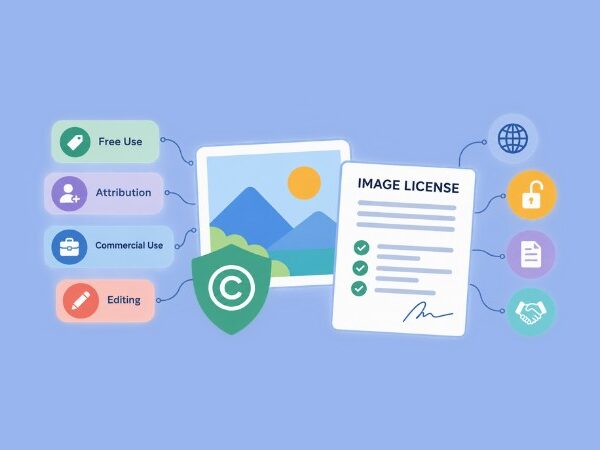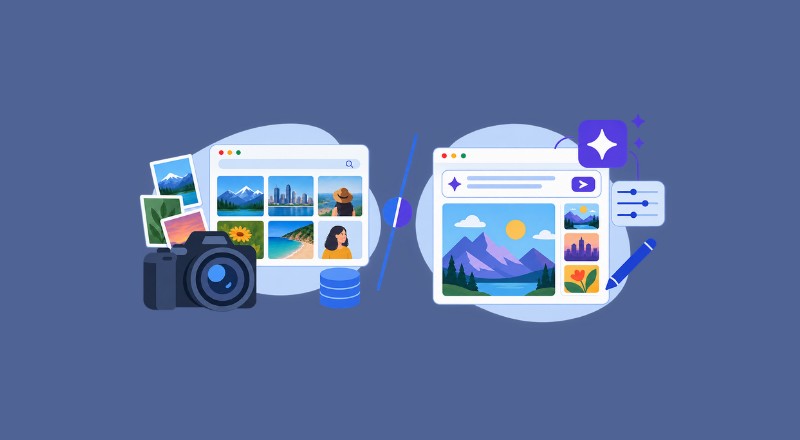
Images can change the way people experience online content. A strong visual can make an article easier to understand, help a product stand out, or simply encourage someone to keep reading.
A poor image can have the opposite effect, especially when it feels generic, irrelevant, or disconnected from the content.
For years, stock photography has been one of the easiest ways to add professional visuals to websites, blogs, social media posts, and content marketing campaigns.
Today, AI image generators have added another option. With a simple prompt, creators can produce images designed around a specific subject, style, composition, and mood.
This creates an important question for bloggers, marketers, designers, and website owners: Stock Photos vs AI Images — how do you choose the right visuals?
No single answer fits every project. Stock photos and AI images have different strengths, limitations, costs, and creative possibilities.
The best choice depends on the purpose of the image, the audience, the brand, the required level of originality, and the rights attached to the visual.
In this guide, we compare stock photos and AI images and look at where each option can make sense.
Stock Photos vs AI Images: What’s the Difference?

Stock photos are images created by photographers, illustrators, or other visual creators and made available through stock libraries. Some stock images are free, while others require a paid license.
Popular sources include commercial stock libraries and free image platforms. Sites such as Unsplash and Pexels offer large collections of images that can be used under their respective licenses.
AI images are created with generative artificial intelligence. Instead of searching through an existing library, you describe the visual you want using a prompt.
For example, imagine writing an article about website performance.
A stock library might offer hundreds of photographs showing laptops, websites, developers, or people working at desks.
An AI image generator could create a custom illustration showing a browser window, optimized images, speed indicators, and a fast-loading website.
That difference is important.
Stock photography starts with an existing image. AI image generation starts with an idea.
Why Images Matter for User Engagement
Images are not simply decoration. A relevant visual can help break up long sections of text and make complicated subjects easier to understand.
Think about how people read online. Large blocks of text can feel intimidating, particularly on mobile devices.
A useful image creates visual breathing room, gives the reader another way to understand the subject, and creates better user engagement.
For example, an article explaining image compression could include a visual showing a large, unoptimized image beside a smaller, optimized version. The image immediately communicates the basic concept before the reader has finished the paragraph.
The same principle applies to AI-generated visuals and stock photography. The key factor isn’t simply having an image—the visual needs to support the content.
Google also recommends using relevant images, descriptive filenames, and useful alt text.
Their image SEO guidance explains that image quality, page relevance, responsive delivery, and descriptive metadata can all help search engines understand images and their surrounding content.
That means your image selection can influence more than appearance. It can also become part of your overall SEO and accessibility strategy.
The Advantages of Stock Photos
Stock photos remain popular for good reasons.
The biggest advantage is convenience. Stock libraries contain enormous collections of ready-to-use photographs, illustrations, vectors, and other visual assets.
If you need a photograph of a person working at a laptop, you can usually find thousands of options within minutes.
Stock images can also provide a high level of photographic quality. Professional photographers understand lighting, composition, perspective, and subject placement. For projects that require realistic photography, this can be extremely useful.
Another advantage is predictability.
When you license a stock image from an established provider, you can review the image before using it. You know exactly what it looks like and can check the applicable license terms.
This can be especially useful for businesses that need professional photography for advertisements, websites, presentations, product pages, or publications.
Stock photography also works well when authenticity matters.
If an article discusses a real location, a genuine product, a specific type of architecture, or a real-world event, an actual photograph may communicate the subject more effectively than a generated image.
The Limitations of Stock Photos
The biggest problem with stock photography is also one of its greatest strengths: the images already exist.
That means other websites may use the same photograph.
A familiar stock image can sometimes make a website feel less distinctive. You may have seen the classic photographs of smiling office teams, people shaking hands, or someone pointing at a laptop screen.
There is nothing inherently wrong with these images. The problem occurs when the visual does not add anything specific to the brand or article.
Stock images can also become difficult to find when you need something very specific.
Imagine you need an illustration showing a website owner comparing three image formats inside a minimalist browser interface. Finding that exact concept as a stock photograph could be difficult.
An AI image generator can potentially create the scene from scratch.
The Advantages of AI Images
The biggest strength of AI images is creative flexibility.
You can describe a specific visual concept and generate an image around it.
For example:

Comparing a Stock Photo With an AI-Generated Image.
A minimalist flat vector illustration showing a website creator comparing a stock photograph with an AI-generated image, clean browser interface, modern web design concept, white background.
That prompt gives you much more control than a conventional stock search.
AI images can also help with abstract ideas.
Topics such as artificial intelligence, digital transformation, cybersecurity, cloud computing, future technology, or data visualization can be difficult to represent with ordinary photography.
An AI-generated illustration can turn an abstract idea into a visual concept.
Another advantage is consistency.
If you’re building a series of articles, you can create visuals with similar composition, colors, shapes, and illustration styles. This can help create a recognizable visual identity across a website.
AI can also be useful when you need several variations of a concept. You can experiment with different compositions and adjust the prompt until the visual fits the page.
The Limitations of AI Images
AI images are not perfect.
Generated images can contain strange details, inconsistent objects, distorted anatomy, incorrect text, or unrealistic lighting. This is particularly important when an image contains people, hands, products, screens, logos, or technical details.
Always inspect an AI-generated image before publishing it.
An image that looks impressive at first glance can contain small errors that become obvious when viewed at full size.
AI images also require more attention to licensing and usage terms.
Different AI services have different rules concerning commercial use, generated content, training data, ownership, and prohibited subjects. Those rules can change, so creators should always check the current terms of the specific tool they use.
Adobe, for example, published detailed guidelines for generative AI content and advises contributors to verify that their AI tool permits the intended commercial use. Adobe also requires AI-generated content submitted to Adobe Stock to be appropriately labeled.
The legal status of AI-generated work can also be more complicated than many people assume.
The U.S. Copyright Office stated in its 2025 report on AI-generated outputs that copyright protection can apply where sufficient human creative expression is present, while merely providing prompts does not by itself establish copyright in the resulting output.
For commercial projects, legal questions can become more complicated, so important projects may require professional legal advice.
Stock Photos vs AI Images: Comparing the Key Factors

The best way to approach the Stock Photos vs AI Images discussion is to look at the actual requirements of your project.
Consider factors such as image quality, originality, cost, licensing, creative control, user engagement, and how well the visual supports your content.
The right choice should improve the reader’s experience while also fitting your website’s visual style, goals, and budget.
Originality
Stock photos can look professional, but popular images may appear across many websites.
AI images can offer more visual originality because the image is generated around your specific concept.
That makes AI particularly interesting for brands that want distinctive illustrations rather than familiar photographic scenes.
Creative Control
Stock photography gives you a selection of existing images.
AI generation gives you greater control over the concept, composition, setting, colors, style, and subject.
However, more control also means more experimentation. Creating the right AI image can require several prompts and revisions.
You can adjust small details until the visual matches your article, brand, or campaign more closely.
This flexibility can be especially useful when you need a unique image that would be difficult to find in a traditional stock library.
Realism
For genuine people, locations, products, and real-world situations, photography often has a natural advantage.
AI can create highly realistic images, but realism is not the same as authenticity.
If your article is about a real restaurant, destination, product, or person, an authentic photograph may be more appropriate.
Real photography can also help build trust by showing readers exactly what a place, product, or person looks like in real life.
Cost
Stock photography ranges from free to expensive depending on the provider, image, license, and intended use.
AI image services commonly use subscriptions, credits, or usage-based pricing. The cost structure can vary significantly between platforms.
Instead of comparing price alone, consider how many images you need and how much time you spend finding or creating them.
Speed
Stock photography can be extremely fast when the right image already exists.
AI can also be fast, particularly for simple concepts, but complex visuals may require multiple attempts.
The fastest option depends heavily on the project. If you have a clear idea but cannot find a suitable stock image quickly, generating a custom AI image may save valuable time.
On the other hand, a ready-to-use stock photo can be the more efficient choice when it already matches your needs.
Licensing
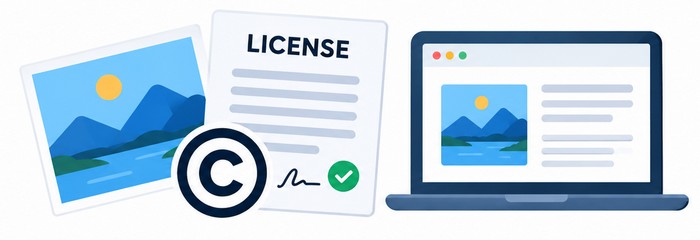
Licensing deserves special attention.
A free image is not automatically free of restrictions. You still need to understand the license and any additional rights involving people, trademarks, property, or other protected elements.
For example, Pexels states that its photos and videos are available for free use under its license, including commercial use, while also noting restrictions involving trademarks, brands, and depicted people.
Unsplash similarly provides a broad license for its images, but its guidance points out that other rights, such as publicity, privacy, property, and trademark rights, can still matter.
Always read the current license before using an image commercially.
When Stock Photos Make More Sense
Stock photos can be a strong choice when realism and speed are the priorities.
A travel article about Stockholm, for example, benefits from genuine photography of the city. A restaurant website may need authentic photographs of its food and location.
An e-commerce business may need professionally photographed products.
Stock images can also work well when you need a visual quickly and can find one that fits the content naturally.
For many projects, there is no reason to create an AI image when an existing photograph already communicates the idea perfectly.
When AI Images Make More Sense
AI images can be particularly useful for conceptual content.
Imagine you’re writing about the future of digital marketing.
You could search for a generic photograph of someone using a computer, or you could create an illustration showing multiple visual concepts connected through an AI-powered creative workflow.
AI can also be useful when you need a very specific composition.
For blog graphics, explainers, conceptual illustrations, diagrams, and creative campaigns, the ability to describe the visual can save time and produce something more closely connected to the content.
This can be particularly valuable for websites that want a consistent illustration style.
Why a Hybrid Approach Can Work Well
The Stock Photos vs AI Images debate does not have to be an either-or decision.
Many websites can use both.
A blog might use authentic stock photography for a travel article, AI-generated illustrations for technology explainers, screenshots for software tutorials, and original product photography reviews.
This approach allows each visual format to perform a specific job.
For PixWizify-style content, for example, a custom AI illustration can explain an abstract image optimization concept, while a real screenshot can demonstrate how an image optimization tool works.
The key is to choose the visual based on its purpose.
How to Choose the Right Visual
Before choosing a stock photo or generating an AI image, ask a few simple questions.
- What does the reader need to understand from this image?
- Does the subject need to be real?
- Does the image need to represent a specific person, place, product, or event?
- Would a custom illustration explain the idea better?
- Do you need a highly specific composition?
- What license applies to the image?
- Will the image remain useful across different screen sizes?
These questions make the decision much easier.
The goal is not to use AI simply because AI is popular. It isn’t to use stock photography simply because it is familiar.
The goal is to choose an image that improves the content.
Don’t Forget Image SEO

After choosing your visual, it is time to optimize it. A well-optimized image can help search engines understand your content while also improving page speed and the overall user experience.
Simple steps such as using descriptive filenames, relevant alt text, and the right image format can make your visuals more useful for both visitors and search engines.
After choosing your visual, optimize it for better SEO.
Use a descriptive filename instead of a generic name such as.
IMG_1234.jpgFor example, gives the image and search engines more context.
stock-photos-vs-ai-images.jpgWrite useful alt text that describes the actual image. Don’t stuff the primary keyword into every alt attribute.
Google specifically recommends descriptive alt text and warns against keyword stuffing. Alt text also improves accessibility for people using screen readers.
Image performance matters too.
Large images can add unnecessary page weight, so resize and compress images before publishing them. Use responsive image techniques so visitors receive an appropriate image size for their device.
The visual should look good without becoming a performance problem.
Stock Photos vs AI Images: The Practical Answer
There is no universal winner in the Stock Photos vs AI Images comparison.
Stock photos provide access to established photography and illustrations, making them useful for realistic subjects, authentic locations, products, and situations where a ready-made visual already fits.
AI images offer greater creative flexibility and can be especially useful for custom illustrations, abstract concepts, unusual compositions, and consistent visual styles.
For many creators, the most practical approach is to use both.
Start with the content.
Think about what the reader needs to see. If an authentic photograph communicates the idea best, look for a suitable stock image. If the concept is highly specific or abstract, an AI-generated visual may be a better fit.
The right image is not simply the one that looks impressive.
It is the one that supports the story, matches the audience, strengthens the page, and gives readers a clearer understanding of the content.
Final Thoughts
The choice between stock photos and AI images has become much more interesting as AI image generation continues to develop.
Stock photography remains useful because it provides access to real photography, established visual quality, and ready-to-license content. AI images open the door to highly customized visuals that can be created around a specific idea.
For website owners and content creators, the smartest workflow is to treat both as creative tools rather than competing technologies.
Use stock photography when authenticity and ready-made quality matter. Use AI images when creative control and customization are more important. Combine them when a project benefits from different types of visuals.
Most importantly, choose images because they improve the reader’s experience.
A relevant, optimized image can do far more than fill a space on a page. It can explain an idea, create visual interest, reinforce your brand, and help readers connect with your content.